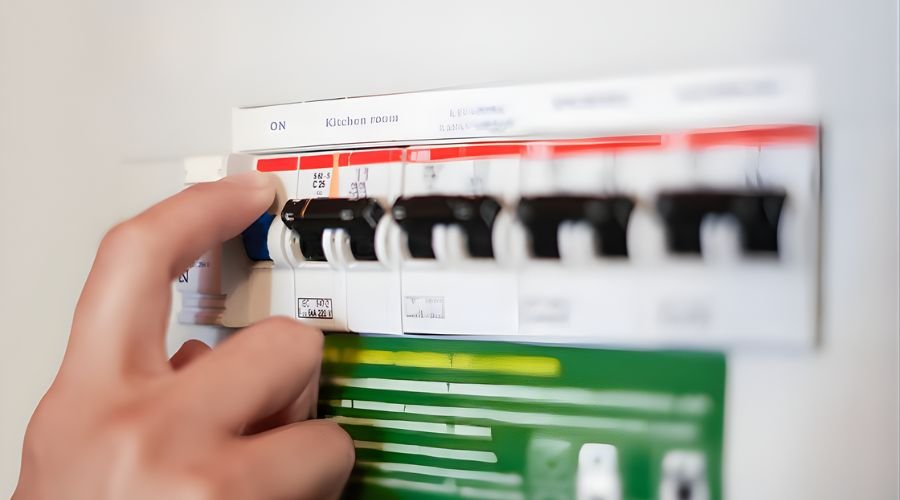
A miniature circuit breaker is one of those components that nobody thinks about until it fails to do its job. And when it doesn’t when a fault develops and the breaker doesn’t trip in time the consequences range from damaged equipment to a house fire. That’s not an exaggeration. It’s just physics.
The MCB circuit breaker market in India is flooded with options at every price point, which makes it genuinely confusing to choose the right one. This post cuts through that confusion and explains what actually matters when selecting an MCB for a residential, commercial, or industrial panel.
What an MCB Actually Does and Why Response Speed Matters
An MCB miniature circuit breaker monitors the current flowing through a circuit. When that current exceeds the rated limit (due to an overload or short circuit), the breaker trips and cuts off power to that circuit. The critical word here is speed.
A slow trip is a liability. During the milliseconds between a fault occurring and the breaker cutting power, heat is building up in your wiring. A fast, reliable trip mechanism is what separates a quality MCB from a cheap one. A quality breaker trips in under 0.1 seconds on a hard short circuit. Some poorly-manufactured units take longer long enough for insulation to begin degrading.
This is why buying MCBs from a supplier with certified stock isn’t just a preference. It’s a specification decision.
Type B, Type C, Type D Getting the Right MCB for the Right Load
MCBs are classified by their trip curve the relationship between current magnitude and trip speed. In India, the three most common types used in residential and commercial applications are B, C, and D.
Type B MCBs trip at 3 to 5 times their rated current. They’re designed for resistive loads lighting circuits, small plug sockets, and general household use. If you’re wiring a bedroom or a living room circuit, Type B is your standard choice.
Type C MCBs trip at 5 to 10 times rated current, making them suited for loads that have a higher inrush current when starting up motors, pumps, compressors, and air conditioning units. A lot of contractors default to Type C for all circuits to avoid nuisance tripping. That works, but it means the breaker is slightly slower to respond on a resistive circuit.
Type D MCBs handle 10 to 20 times rated current before tripping. They’re for specialist industrial equipment with very high startup surges welding machines, industrial motors, heavy compressors. Using a Type D on a domestic circuit gives you almost no protection against overloads.
Getting this wrong doesn’t mean the breaker won’t work at all. It means it might trip too easily (causing inconvenience) or not trip fast enough (causing a safety risk). The selection matters.
Current Rating the Number Everyone Reads, and What It Actually Means
The current rating on an MCB 6A, 16A, 32A, 63A is the continuous current the breaker can carry without tripping. It should be matched to the circuit it’s protecting, not to the maximum possible load.
For a standard lighting circuit in an Indian home, a 6A or 10A MCB is typically used. General plug socket circuits usually run on 16A or 20A. A dedicated circuit for a 1.5-ton air conditioner would typically use a 16A or 20A MCB, depending on the unit’s specifications. A geyser circuit usually runs on a 20A MCB.
A common mistake is over-rating fitting a 32A breaker on a circuit that only ever draws 10A because someone thought bigger meant safer. It doesn’t. A higher-rated MCB won’t trip until the current hits its threshold, meaning your wiring could be carrying more current than it was designed for before the breaker acts.
What to Look for When Buying an MCB in India
First: IS/IEC 60898 certification. An MCB for use in India should comply with this standard it covers tripping characteristics, temperature performance, and endurance. Don’t buy MCBs without confirming this.
Second: short circuit breaking capacity. This is rated in kA (kiloamperes) and tells you the maximum fault current the MCB can safely interrupt. For most residential applications in India, a 6kA breaking capacity is standard. Industrial panels often require 10kA or higher.
Third: the physical fit. MCBs should be DIN-rail mountable for proper installation in a distribution board. Check that the pole configuration matches your panel single pole for single-phase circuits, three-pole or four-pole for three-phase industrial applications.
Mercury Electrix stocks MCBs across Type B, C, and D curves in a full range of current ratings and breaking capacities all IS/IEC certified. If you’re building out a residential DB or a commercial panel and you’re not sure what spec to order, reach out and we’ll confirm what you need.
Planning a panel or DB upgrade? Tell us your load schedule and we'll help you spec the right MCB configuration.